How To Manage Affiliates? The Definitive SaaS-Focused Guide
The success of any B2B SaaS affiliate program hinges not just on the software you offer but on the strength of the relationships you build with your affiliate partners. These … How To Manage Affiliates? The Definitive SaaS-Focused Guide
A B2B SaaS affiliate program lives or dies on the relationships behind it, not on the software alone. The partners you recruit decide how far your product travels and how much of your revenue arrives without a salesperson touching it.
Those relationships turn affiliates into advocates who put your product in front of buyers your own marketing team never reaches, in a voice those buyers already trust.
Getting there takes a mindset shift. Stop treating affiliates as external contractors and start treating them as an extension of your revenue team.
This guide covers how to manage affiliates across the whole journey, from the first application through onboarding, support, tracking and payouts.
You will see how to pick affiliates worth your time, get them promoting quickly, support them past the basics, and build a reward system that keeps the good ones producing month after month rather than fading after one referral.
The focus throughout is B2B SaaS, where the payout is recurring and the sales cycle is longer than a coupon click.
That includes communication that keeps affiliates informed instead of guessing, tying affiliate goals to your MRR targets, and the affiliate marketing tooling you need to track partner performance and act on it.
Each section ends with tactics you can apply, whether your program is just starting out or already large.
#1 Managing affiliate intake: Strategies to recruit top affiliates
Who you let into a B2B SaaS affiliate marketing program sets the ceiling for everything that follows. Affiliates who never send a signup cost you more admin than a smaller group who refer consistently, so affiliate recruitment should be judged on fit rather than headcount. Three levers decide the outcome: the offer you put in front of candidates, the verification you run before approving them, and the onboarding that moves them from approval to first referral.
Make your program the one affiliates choose over the alternatives
Experienced affiliates compare programs before they apply. They check the commission rate, the cookie window, whether payouts recur, and whether the B2B SaaS product converts once they send traffic. Your job is to make those answers obvious on the program page instead of burying them behind an application form.
Three things move the needle on how your program reads to a serious affiliate:
- Offer competitive commissions: State the rate, the recurring period and the cookie window in plain terms. Then show worked examples of what an affiliate earns at different referral volumes, so the maths is already done for them.
- Showcase real success stories: Publish case studies and testimonials from your best affiliates. Name the numbers they hit, the channel they used and the support they received. A named affiliate earning a stated amount each month tells a candidate more about your program than any adjective on the landing page, and it gives them a template to copy.
- Highlight exclusive benefits: Money is not the only lever. Offer early access to new releases, a heads-up on roadmap changes before they ship, and a say in upcoming affiliate campaigns. Those perks cost little and they make affiliates feel like partners in your SaaS growth rather than a traffic source.
Pro tip: list your program where SaaS affiliates already look, such as the Reditus Marketplace
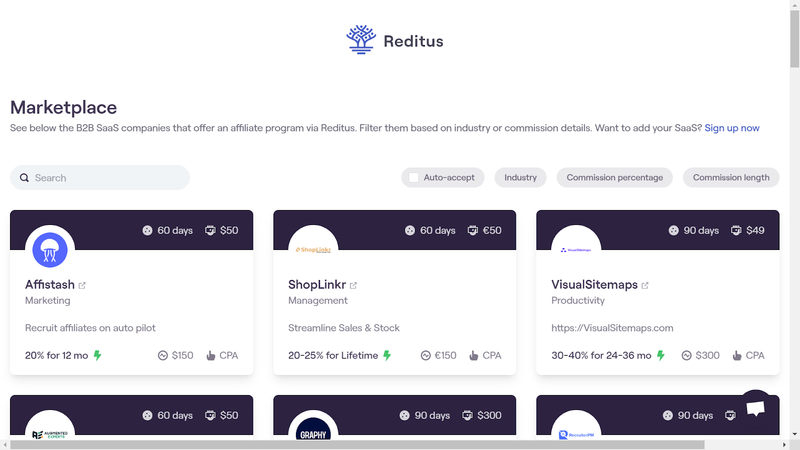
A screenshot from the Reditus Marketplace landing page.
The Reditus Marketplace puts your program in front of over 26,000 B2B SaaS affiliates who are already vetted for their interest in B2B SaaS products. Rather than chasing candidates one at a time, you list the program once and affiliates apply to you through a single, streamlined application process.
For example, Expandi’s run within the Reditus Marketplace shows what that looks like in practice. They went from a small internal partner list to a working affiliate channel in six months, signing over 70 B2B SaaS affiliates and generating almost $10k MRR from partners recruited via the marketplace.
Verify every applicant before you approve them
Approval is the one moment where you control who speaks for your product. A proper check filters out coupon sites, scraped-content blogs and anyone whose audience has nothing to do with your buyer, and leaves you with affiliates whose reach and tone match your brand and your target audience.
Joran Hofman, founder of Reditus, one of the leading SaaS affiliate platforms, puts it this way:
“Start with quality affiliates to minimize time wastage and maximize results. It’s crucial to ensure affiliates align with your target audience and values.”
Joran Hofman, founder of Reditus
For a SaaS program, verification usually comes down to three checks:
- Conduct background checks: Before working with affiliates, look at their site, social profiles and existing content. Check whether the content is original, whether the audience engages with it, and whether they cover your software category at all. A blog with traffic but no relevance to your buyer will not convert.
- Establish clear quality criteria: Write down what you allow and what you do not: brand bidding, coupon sites, review standards, disclosure rules. Publishing those terms up front self-selects affiliates who will follow them and meet compliance needs.
- Engage via active recruitment services: Waiting for applications only takes you so far. Alongside the self-service marketplace, Reditus runs recruitment on your behalf, identifying affiliates who already reach your ICP and pitching your program to them. It takes longer than waiting for applications to arrive and it produces partners who fit your affiliate marketing strategy.
Get new affiliates from approval to first link fast
The window straight after approval is when an affiliate is most willing to act, and it is easy to waste. Every day between approval and first promotion is a day their enthusiasm drops and a competing program gets their attention instead. Onboarding done well hands them their link, the product knowledge and the assets inside that window, without making them chase you for any of it.
Joran makes the point that affiliates do not all want to be onboarded the same way:
“Not every affiliate wants to have a call. Onboard them efficiently with email sequences, catering to their preferences and language barriers.”
Joran Hofman, founder of Reditus
Efficiency here is not only speed. It means an onboarding path that works for the affiliate who wants a call, the one who wants a document to read, and the one whose first language is not English.
Four things to have in place before your next affiliate is approved:
- Implement automated email sequences: As an affiliate manager, set up a sequence that drips the product overview, the commission terms and the asset library. Partners work through it at their own pace, they learn your program policies without a call, and you stop retyping the same answers.
- Create interactive onboarding checklists: Give affiliates a short checklist they can work through at their own pace: generate their affiliate links, read the product one-pager, place a first mention, and find their performance report. A short, visible list is easier to finish than a welcome PDF.
- Provide personalized dashboards to affiliates: Give each affiliate one place that holds their links, their marketing assets, their onboarding steps and their live performance numbers. A single reference point means fewer support questions and no hunting through old email for a banner. Affiliate management software such as Reditus sets this up for you.
- Regularly update onboarding materials: Every product release dates your onboarding content. Put a recurring review in the calendar so screenshots, pricing pages and feature descriptions match what a prospect will actually see, regardless of when the affiliate joined.
Attracting, verifying and onboarding are the three steps that decide who is in your program and how quickly they start. Everything in the next section assumes those are in place, because support given to badly matched affiliates is effort you never get back.
#2 Managing affiliate support: Strategies to empower your partners with resources
Affiliates often go quiet not because they quit but because they never got what they needed to publish anything. Support closes that gap: the assets, the product knowledge and the answers that let a partner ship a review, a comparison post or a newsletter mention without waiting on you. The three approaches below cover what to give them, and when.
Match your support to how each affiliate actually promotes
A YouTube reviewer, an SEO blogger and a consultant embedding your tool in client work need completely different things from you. The reviewer wants a demo account and a script outline, the blogger wants screenshots and data, the consultant wants a deck and a margin. One generic asset pack serves none of them well, so build the support system to flex.
Joran makes the same point about tailoring resources:
“Provide affiliates with resources tailored to their promotional methods. Understand their needs to support their efforts effectively.”
Joran Hofman, founder of Reditus
Two moves cover most of that variation without building bespoke support for every partner:
- Conduct affiliate surveys: Ask your affiliates regularly which channel they promote on, what is blocking them, and which resource they wish they had. The answers tell you what to build next instead of guessing, and they surface churn risk early.
- Offer a range of promotional assets: Build a library that covers every format your affiliates use: blog copy and screenshots, video footage, social posts sized per network, and email marketing templates. Cover the formats and every affiliate finds something that suits their audience and their style.
Shorten the gap between signing up and the first referral
An affiliate who earns a commission early has a reason to continue. One still assembling their own screenshots has not started promoting yet. Handing over ready-made resources at the start compresses the time from onboarding to active promotion, which is a number worth tracking in a young program. It also lets affiliates spend their initial enthusiasm on promotion instead of preparation, and see a return early enough to keep going.
“Providing ready-to-use materials accelerates affiliates’ journey towards generating referrals. Facilitate time to value by providing resources upfront,” advises Joran.
Four resources worth having ready before you approve anyone:
- Develop actionable resource kits: Package assets by channel rather than dumping them in one folder, and include a short guide on using each one. A blogger kit with screenshots, product facts and a comparison angle. A social kit with sized images and hooks. An email kit with subject lines and copy. Each should let an affiliate start without asking you a question.
- Offer customizable templates and boilerplate copies: Supply editable templates for emails, social posts and blog articles, plus an approved product description and a one-line pitch. Templates speed up content creation and keep your positioning consistent, while still leaving affiliates room to adapt the message to their own audience.
- Launch a ‘first campaign’ success plan: Write one prescriptive plan for an affiliate’s first campaign: which angle to lead with, which asset to use, where to place the link, and what result to expect. New affiliates rarely lack effort, they lack a decision about where to start, and a plan that works builds their confidence in your program.
- Facilitate hands-on experience: Give approved affiliates a complimentary or discounted account so they use the software before they write about it. Affiliates who have run a real workflow in your product write reviews that convert, because the detail is theirs rather than yours.
Find what works, then spread it across the network
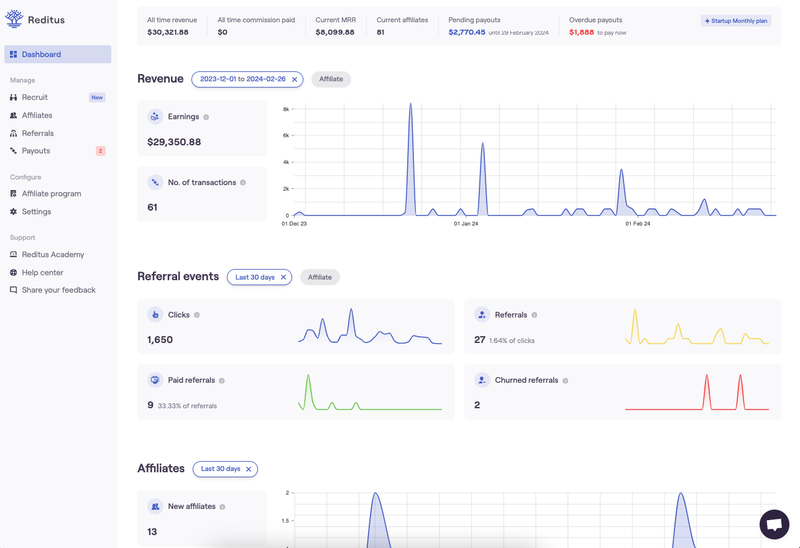
Screenshot of a dashboard screen that Reditus offers to SaaS affiliate marketing teams for program management and insights.
Some affiliates will outperform the rest, and the reason is usually visible in the data: a specific page, a specific angle, a specific traffic source. Find that pattern in your performance metrics, then teach it to everyone else so the whole network improves rather than a handful of partners.
Joran frames the payoff of doing this well:
“By utilizing insights from affiliate performance, we can identify and emulate successful tactics, thereby amplifying the program’s overall effectiveness.”
Joran Hofman, founder of Reditus
Four steps that turn affiliate performance data into network-wide gains:
- Extract key success strategies from performance data: Break performance down by affiliate, landing page and traffic source, then look at what your highest converters have in common. It is usually one repeatable thing, a comparison post, a specific keyword, a webinar format, that you can then steer the rest of your affiliates toward.
- Broadcast successes for broader adoption: Send a short, regular note naming what worked, which affiliate did it and what it earned. Specifics travel through a network and get copied; a general reminder to promote more does not.
- Host strategy optimization workshops: Run a group session or a one-to-one coaching call where you walk through the data with affiliates and rework their tactics against it. Showing a mid-tier affiliate exactly which of their pages converts is usually enough to change what they publish next.
- Set up an online partner community: A moderated Slack group or forum lets affiliates answer each other’s questions and trade what is working. It cuts your support workload and spreads winning tactics faster than you can circulate them yourself.
Support comes down to three things: resources matched to how each affiliate promotes, everything they need available from day one, and performance insight shared back so the network learns from its top performers. Do those and your partners stop waiting on you, which is the point of the whole exercise.
#3 Managing affiliate tracking and performance: Strategies to motivate partners with rewards
Tracking and rewards are where affiliate programs are won or lost. If an affiliate cannot see the click that became a trial, or the trial that became a paying account, they assume the tracking is broken and stop sending traffic. Accurate attribution paired with a payout structure worth chasing is what keeps partners engaged past their first few referrals, and what turns a list of signups into a channel.
Below: how to give affiliates visibility into their own numbers, how to set performance-based incentives, and how to keep rewards fresh so engagement holds.
Give affiliates full visibility into their own numbers
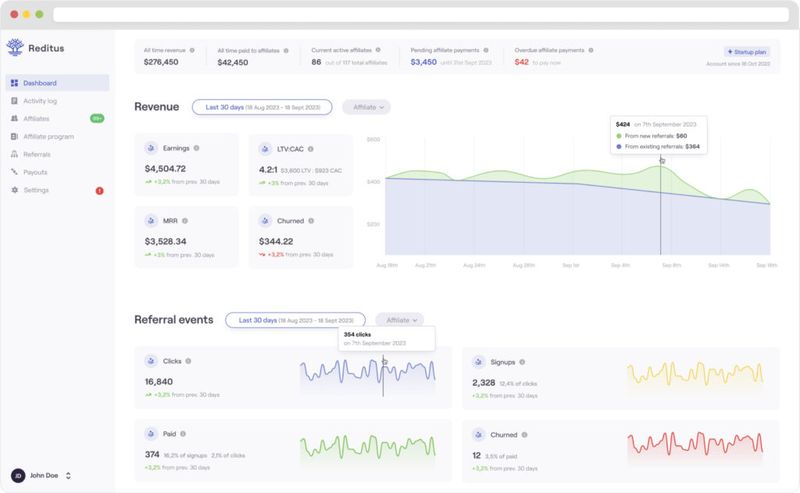
Every affiliate managed through the Reditus platform gets their own performance dashboard packed with useful data and insights.
Affiliates cannot improve what they cannot see, and they will not trust a commission figure that appears without explanation. Open performance data solves both problems at once. When a partner can follow the chain from click to trial to paying account to commission, the payout stops being a number you assert and becomes something they can check for themselves. That is what makes an affiliate comfortable putting more effort into your program instead of a competitor’s, and it is why transparency belongs in the tracking setup rather than in the welcome email.
Four things that make that visibility real in practice:
- Run the program on dedicated software like Reditus: Affiliate management software gives every partner a personalized dashboard showing real-time clicks, conversions and earnings, rather than a spreadsheet you update monthly. Affiliates who can watch their own numbers move tend to optimize their campaigns without being asked.
- Ensure data accuracy and freshness: Check that conversions land in the dashboard promptly rather than at month end,. Affiliates make decisions about their promotional strategies off these numbers, and one visible discrepancy costs trust that is slow to rebuild.
- Facilitate open discussions on data insights: Invite affiliates to bring their numbers to the community or to a call with the program manager. Talking through a low conversion rate together usually turns up a fixable cause, a mismatched landing page or an audience that was never your ICP, and the fix spreads to everyone listening.
- Notify key milestones: Trigger an automatic message when an affiliate lands their first paying referral, crosses a conversion threshold, or passes an earnings milestone. It marks the achievement, and it quietly proves your tracking is running and recording their work accurately.
Structure commissions so producing more pays more
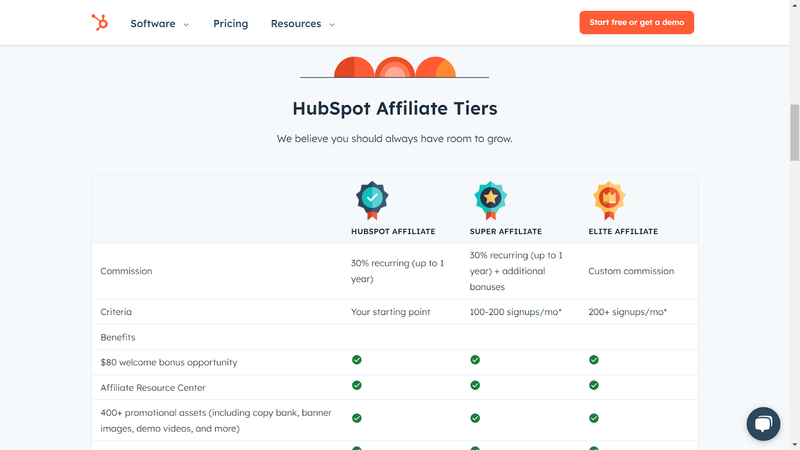
Screenshot of tiered commission plans from HubSpot’s affiliate program landing page.
A flat commission gives an affiliate no reason to send more referrals than they already do. A structure that pays more at higher volume does, and it fosters partnerships that last.
“Performance-based incentives propel affiliates towards greater accomplishments, enhancing both individual and program growth.”
Joran Hofman, founder of Reditus
Three ways to build that into your commission structure:
- Implement tiered commissions: Set thresholds where the rate rises as affiliates meet and exceed targets, so the next referral is worth more than the last and improving their strategy pays off directly. For a reference point most SaaS affiliates already know, look at HubSpot’s affiliate program, which offers a 30% recurring commission for each referred customer, with higher tier levels unlocked by hitting a set range of monthly signups. Publish your tiers and thresholds so affiliates can see what the next level pays and how far off it they are.
- Reward exceptional performance: Recognize affiliates who clear their targets by a wide margin with a bonus or a rate bump outside the standard tier ladder.
- Publicly celebrate success: Name your top performers in the affiliate community or on your own channels. Recognition costs nothing, it gives the affiliate proof of results they can use elsewhere, and it shows the rest of the network what a strong month looks like.
Pay them sooner than feels necessary
Payout thresholds of $200, and sometimes $500, are still common, and they quietly suppress the activity you are trying to create. Even $100, which sounds reasonable from where you sit, usually means an affiliate has to produce five to ten commissions before any money reaches them. For somebody who joined recently, that is a long time to wait for proof that your program pays at all.
Set the threshold so a partner gets paid after two or three commissions. The first payout is the point at which the relationship becomes real to them, and pulling it forward does more for engagement than most incentive schemes. Flexibility on method and currency matters just as much: insisting on a single payout rail costs you good affiliates, agencies and consultancies included.
Keep the rewards moving so engagement does not stall
A commission plan that never changes stops registering. A rewards system that recognizes short-term wins as well as long-run loyalty gives affiliates something to aim at now and a reason to stay.
Strategies for a dynamic rewards system include:
- Refresh incentives periodically: Introduce a new bonus or challenge at regular intervals, tied to a launch or a seasonal push. New challenges and rewards give dormant affiliates a reason to come back and stop engagement plateauing.
- Conduct annual recognition events: Hold one event a year, online or alongside a conference, where you review what the network produced and name the people behind it. It strengthens the community bond and turns a list of accounts into a group who know each other and know their contribution was counted.
- Iterate based on affiliate feedback: Ask affiliates directly what would make the rewards worth more effort. Some want a higher rate, some a longer cookie window, some faster payouts. Adjusting on their answers keeps your incentives competitive as other SaaS programs change their terms.
Visible tracking, commissions that pay more at higher volume, and rewards that change over time are what keep affiliates producing once the novelty of joining wears off.
What managing affiliates actually looks like in a week
The strategies above describe what to do. This is the rhythm they run on, taken from customers whose programs are performing.
Monday morning: campaign applications, program applications, and the content submissions queued for review.
Day to day: deciding who to accept, deciding which content to accept, and working with affiliates until what they produce is actually good. It is repetitive and often tedious. Accepting thin or AI-written content to save the effort defeats the point, because that content will not rank and unranked content earns nobody anything.
Weekly: recruitment continues regardless of how the program is doing. Who can you bring in, who can you activate.
Monthly and quarterly: clicks and referrals as trend lines rather than snapshots, plus signup quality and progression to paid for teams pushing data into a CRM.
The counterfeit version is worth naming, because it is common: onboarding emails are automated, someone asks how the program is going every few weeks, and nothing that would grow it ever gets done. That is observing a program, not managing one. A fully automated program has the same problem in a more expensive form, because once everything runs itself you no longer know what your own numbers mean.
Put affiliate management on a platform built for B2B SaaS
This guide has covered the full arc of affiliate management: recruitment and verification, onboarding, ongoing support, performance tracking and rewards.
The thread running through all of it is the relationship. Affiliates who are treated as partners promote your SaaS product to audiences your own team cannot reach, and they keep doing it, which is where affiliate-driven revenue comes from.
You now have the pieces: how to choose affiliates who match your ICP, how to move them from approval to first referral quickly, how to support them by channel rather than generically, and how to build a rewards system that pays more as they produce more. Together those align what the affiliate is chasing with the MRR you are trying to grow, and that alignment is what makes the partnership work for both sides.
Running all of this on spreadsheets stops working as your program grows. You need affiliate marketing tools that handle tracking, payouts and reporting so managing partners does not become a full-time job.
Built for one thing, setting up, managing and scaling B2B SaaS affiliate marketing programs, Reditus covers the strategies above with much less hassle.
Personalized dashboards handle the transparency side, the SaaS-focused marketplace and recruitment services handle sourcing top-tier affiliates,.
Take a closer look at the Reditus platform and see how it handles the recruitment, onboarding and payout work you are doing by hand today.
Request a demo of Reditus today and we will go through your B2B SaaS affiliate program and where the next gain is most likely to come from.
Once your management processes are solid, move on to growth strategies for mature programs and push the numbers further.

Meet the author
Back in 2020 I was an affiliate for 80+ SaaS tools and I was generating an average of 30k in organic visits each month with my site. Due to the issues I experienced with the current affiliate management software tools, it never resulted in the passive income I was hoping for. Many clunky affiliate management tools lost me probably more than $20,000+ in affiliate revenue. So I decided to build my own software with a high focus on the affiliates, as in the end, they generate more money for SaaS companies.

What Is Affiliate Management and How To Do It Right in 2026?
Affiliate programs are critical growth engines for SaaS startups. They drive new signups and expand market reach through external partners. However, robust management is the backbone of any effective program. … What Is Affiliate Management and How To Do It Right in 2025?

SaaS Affiliate Marketing: How to Start and Scale an Affiliate Program
A practical guide to launching a SaaS affiliate program, growing it into a real revenue channel, and migrating one that has stalled. Built from what actually works for B2B SaaS.

What is Affiliate Marketing Strategy: Guide for B2B SaaS
Wondering what is affiliate marketing strategy? Our comprehensive guide offers actionable steps and proven strategies to elevate your B2B SaaS business.